 Photo: Unsplash
Your FCRA and FDCPA Rights: A Handbook for Collection Letters and Credit Disputes
Got a collection letter or a collection on your credit report? Learn the FCRA and FDCPA rights that apply, how to enforce them with letters and CFPB complaints, and when to call a consumer attorney.
A letter from a collection agency, or a collection that suddenly shows up on your credit report, can feel like the other side holds all the cards. It doesn't. Two federal laws, the Fair Credit Reporting Act (FCRA) and the FDCPA, give you specific rights: to demand that a collector back up what it says you owe, to dispute inaccurate reporting, and to hold companies accountable when they break the rules. This handbook explains those rights and how to use them.
Key Takeaways
- The FCRA gives you the right to dispute any inaccurate information on your credit report and requires bureaus to investigate within 30 days
- The FDCPA prohibits collection agencies from using harassment, deception, or unfair practices and lets a court award statutory damages of up to $1,000 per lawsuit
- You are entitled to free credit reports from each bureau through AnnualCreditReport.com, and lenders must notify you when they first report negative information
- You can file free CFPB complaints, and companies generally respond within 15 days, often resolving issues faster than litigation
- Many consumer rights attorneys take FCRA and FDCPA cases on contingency, meaning you pay nothing unless you win
- State laws often provide additional protections beyond federal law, including higher penalties and broader coverage
The FCRA: Your Credit Report Rights
The Fair Credit Reporting Act (FCRA), codified at 15 U.S.C. § 1681, is the federal law that regulates how consumer reporting agencies (credit bureaus) collect, maintain, and distribute your credit information. Originally enacted in 1970 and significantly strengthened by the Fair and Accurate Credit Transactions Act (FACTA) in 2003, it gives you powerful rights over your own credit data.
The FCRA applies to the three major credit bureaus (Experian, Equifax, and TransUnion), specialty consumer reporting agencies, and any entity that furnishes information to these agencies (banks, lenders, collection agencies). It creates obligations for all parties in the credit reporting ecosystem.
Key FCRA Rights
Right to Access Your Report
Section 612Right to Dispute Inaccuracies
Section 611Right to Timely Removal
Section 605Right to Limit Access
Section 604Right to Sue for Violations
Sections 616-617Right to Notice
Section 615The Furnisher's Duty Under Section 623
The FDCPA: Your Rights With Collection Agencies
The FDCPA, codified at 15 U.S.C. § 1692, was enacted in 1977 to stop abusive collection practices. It applies to third-party collection agencies and many companies that buy delinquent accounts (not original creditors collecting their own accounts, though many states extend similar rules to them).
The FDCPA covers personal, family, and household accounts, including credit cards, auto loans, medical bills, mortgages, and student loans (when collected by third parties). It does not cover business accounts. Key protections include restrictions on when and how collectors can contact you, prohibitions on deceptive and unfair practices, and your right to dispute what a collector says you owe and demand verification.
Regulation F Updated the Rules in 2021
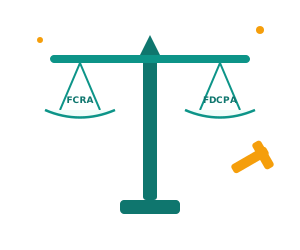
FCRA vs FDCPA: Side-by-Side Comparison
FCRA vs FDCPA
| Feature | FCRA | FDCPA |
|---|---|---|
| Who it protects | Anyone with a credit report | Consumers contacted by third-party collectors |
| Who it regulates | Credit bureaus and data furnishers | Collection agencies and account buyers |
| Key right | Dispute inaccurate credit information | Dispute and demand verification within the validation period |
| Investigation timeline | 30 days (45 with additional info) | No set deadline, must cease collection until validated |
| Statutory damages | $100-$1,000 for willful violations | Up to $1,000 per lawsuit |
| Punitive damages | Available for willful violations | Not available (actual + statutory only) |
| Attorney's fees | Yes, for successful plaintiffs | Yes, for successful plaintiffs |
| Lawsuit statute of limitations | 2 years from discovery or 5 years from violation, whichever is earlier | 1 year from violation |
| Class action cap | No statutory cap | Lesser of $500,000 or 1% of net worth |
| Enforcement agency | CFPB, FTC, state AGs | CFPB, FTC, state AGs |
Know Your Rights. Enforce Them.
Clear Collection Notice drafts your response to the collector and your credit bureau disputes, citing the FCRA and FDCPA sections that fit your situation.
Enforcement Strategies
Knowing your rights is only half the battle. The other half is using them effectively. Federal consumer protection laws are only as powerful as your willingness to invoke them. Here is how to put theory into practice.
Always communicate in writing
Phone calls leave no paper trail. Every dispute, validation request, and complaint should be sent via certified mail with return receipt requested. Written communication creates evidence that is admissible in court and cannot be denied.Cite specific statutes in your letters
When disputing with a bureau, reference FCRA Section 611. When requesting validation from a collector, cite FDCPA Section 809 (15 U.S.C. §1692g). When reporting harassment, cite Section 806. Specific legal references signal that you know your rights and are prepared to enforce them.Set deadlines and follow up
The FCRA gives bureaus 30 days to investigate. Note that deadline in your dispute letter. If they miss it, send a follow-up citing their failure. Each missed deadline is a potential violation that strengthens your position.Dispute with all relevant parties simultaneously
When information is inaccurate, dispute with the credit bureau under the FCRA and with the data furnisher directly under Section 623. If a collector is involved, send a validation letter under the FDCPA. This multi-front approach maximizes pressure.Document everything chronologically
Maintain a file for each dispute with dated copies of every letter sent and received, certified mail receipts, phone call logs (date, time, caller, content), and credit report snapshots. This chronological record is essential for any legal action.
The Power of the Paper Trail
CFPB Complaints
The Consumer Financial Protection Bureau (CFPB) is the primary federal agency responsible for enforcing consumer financial protection laws. Filing a CFPB complaint is free, can be done online at consumerfinance.gov/complaint, and the CFPB forwards it to the company, which is generally expected to respond within 15 days.
CFPB complaints can be effective. Companies know that complaint patterns can draw regulatory attention and enforcement actions, so many take complaints seriously and try to resolve them.
Gather your documentation
Before filing, collect all relevant documents: dispute letters and responses, credit report excerpts showing the error, collector correspondence, and a chronological summary of events. The more specific you are, the stronger your complaint.File at consumerfinance.gov/complaint
Choose the product category that fits (credit reporting for a bureau problem, or the collections category for a collector), describe the issue clearly with dates and specifics, upload supporting documents, and state what resolution you want. Be factual and avoid emotional language.Monitor the company's response
The company is generally expected to respond within 15 days. You will receive a notification when it does. Review the response carefully. If it does not resolve the issue, you can give feedback on the response through the CFPB portal.Escalate if unsatisfied
If the company's response is inadequate, say so in your CFPB feedback. Also consider filing a complaint with your state Attorney General and consulting a consumer rights attorney. The CFPB complaint and response become evidence in any subsequent legal action.
CFPB Complaints Create Legal Leverage
State Consumer Protection Laws
Federal laws (FCRA and FDCPA) set the floor for consumer protections, but many states have enacted additional laws that provide stronger remedies, broader coverage, or longer statutes of limitations. Understanding your state's laws can significantly enhance your legal position.
Notable State Laws
New York (GBL Section 601): New York General Business Law restricts collection practices beyond the federal FDCPA and provides for additional state-level penalties. New York City has its own Department of Consumer and Worker Protection.
Texas (Finance Code Chapter 392): Texas's state collection statute applies to original creditors as well as third-party collectors, requires many third-party collectors to post a bond, and lets consumers sue for actual damages and injunctive relief.
Illinois (Collection Agency Act): Illinois requires collection agencies to be licensed and sets its own conduct rules for how they collect. Illinois also has strong identity theft protections.
Check your state Attorney General's website for consumer protection resources specific to your state. Many state AGs maintain consumer complaint portals that work alongside the federal CFPB system.
When to Hire an Attorney
Many credit report and collection problems can be resolved through self-advocacy: dispute letters, validation requests, and CFPB complaints. However, certain situations warrant professional legal help. Consumer rights attorneys specialize in FCRA and FDCPA cases and often work on contingency, meaning you pay nothing unless they win your case.
Consider hiring an attorney when:
- A credit bureau has failed to correct inaccurate information after multiple disputes
- A collection agency has clearly violated the FDCPA (harassment, threats, continued collection after a timely dispute without verifying)
- You have suffered concrete financial harm (denied mortgage, lost job, higher interest rates) due to inaccurate reporting
- A collector is suing you over an account you do not owe or one that is past the statute of limitations
- You have documented multiple violations and want to maximize your recovery
- You need help navigating complex situations like identity theft, mixed files, or corporate fraud
The National Association of Consumer Advocates (NACA) at consumeradvocates.org maintains a searchable directory of consumer rights attorneys by state and specialty. Many offer free initial consultations.
Do You Have Grounds for Legal Action?
Do You Have Grounds for Legal Action?
Answer these 5 questions to assess whether your situation may warrant legal action under the FCRA or FDCPA.
Have you disputed inaccurate information with a credit bureau, and did they fail to investigate or correct it within 30 days?
Start Protecting Your Rights Today
Answer a few questions about your collection letter and Clear Collection Notice drafts the response and the bureau disputes, with the right legal citations. Your first printable letter is free.
Get Started FreeProtecting Yourself Going Forward
Once you have resolved current issues, take proactive steps to prevent future problems and ensure you can quickly detect and address any new inaccuracies.
Monitor your credit reports regularly
Check your credit reports from all three bureaus at least quarterly through AnnualCreditReport.com (currently offering free weekly access). Set up free credit monitoring through your bank, credit card, or a service like Credit Karma to get alerts for new activity.Place fraud alerts or credit freezes
If you have been a victim of identity theft, place a fraud alert (requires creditors to verify your identity before opening new accounts) or a credit freeze (blocks most new creditors from accessing your credit report). Freezes are free under federal law since 2018.Keep a dispute documentation system
Maintain organized files for any future disputes. Include copies of your credit reports, dispute letters, certified mail receipts, and responses. Digital copies stored securely in the cloud ensure you never lose critical evidence.Know your state's laws
Research your state's consumer protection laws, collection agency rules, and statute of limitations periods. Bookmark your state AG's consumer complaint portal. Understanding local rules gives you additional tools beyond federal law.Opt out of prescreened offers
Reduce marketing access to your credit file by opting out of prescreened credit and insurance offers at optoutprescreen.com or by calling 1-888-5-OPT-OUT. This limits who can pull your credit for marketing purposes.
Avoid Credit Repair Scams
Frequently Asked Questions
Deep Dive Articles
Explore these related articles for detailed guidance on specific topics covered in this guide.
FCRA Explained
A plain-English guide to the Fair Credit Reporting Act. Learn how it lets you dispute collection accounts and other credit report errors, how long negative items can stay, and what to do when a bureau won't fix a mistake.
FDCPA Guide
Got a collection letter or calls from a collection agency? Learn what the FDCPA lets collectors do and forbids, how to request validation, how to stop the calls, and when to sue.
CFPB Complaints
When a collection agency ignores your validation request or a credit bureau won't fix an error, a CFPB complaint can get results. Learn when to file, what to include, and what happens next.
Statute of Limitations
Got a collection letter for an old account? Learn how the statute of limitations works, how it differs from credit reporting limits, and what restarts the clock.
Credit Repair Warnings
Got a collection on your credit report and a credit repair company promising to erase it? Learn the scam red flags, what the CROA protects, and how to handle collections yourself.
Related Articles
The FCRA Explained: Your Rights When a Collection Hits Your Credit Report
A plain-English guide to the Fair Credit Reporting Act. Learn how it lets you dispute collection accounts and other credit report errors, how long negative items can stay, and what to do when a bureau won't fix a mistake.
14 min readLegal RightsThe FDCPA Explained: Your Rights When a Collection Agency Contacts You
Got a collection letter or calls from a collection agency? Learn what the FDCPA lets collectors do and forbids, how to request validation, how to stop the calls, and when to sue.
15 min readLegal RightsHow to File a CFPB Complaint Against a Collection Agency or Credit Bureau
When a collection agency ignores your validation request or a credit bureau won't fix an error, a CFPB complaint can get results. Learn when to file, what to include, and what happens next.
10 min readLegal RightsStatute of Limitations on Collections: State-by-State Guide
Got a collection letter for an old account? Learn how the statute of limitations works, how it differs from credit reporting limits, and what restarts the clock.
11 min readLegal RightsCredit Repair Companies and Collections: Red Flags, Scams, and Your Rights
Got a collection on your credit report and a credit repair company promising to erase it? Learn the scam red flags, what the CROA protects, and how to handle collections yourself.
10 min readCollection LettersValidation Request Letter: How to Respond to a Collection Notice
Got a letter from a collection agency? Learn how a validation request letter makes the collector verify the account before it keeps collecting, and what proof to ask for.
10 min read